

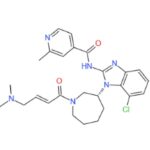
Nazartinib (EGF-816)

Nazartinib (EGF-816) (CAS No.: 1508250-71-2), a covalent mutant-selective EGFR inhibitor, with Ki and Kinact of 31 nM and 0.222 min-1 on EGFR(L858R/790M) mutant, respectively. >98% Purity.
Synonyms: EGF-816, EGF816, EGFR inhibitor, epidermal growth factor receptor inhibitor
For Research Use Only.

产品参数
| 货号 | APIM050413 |
|---|---|
| 产品名称 | Nazartinib (EGF-816) |
文献
APIM050413: Nazartinib (EGF-816) is a covalent mutant-selective EGFR inhibitor, with Ki and Kinact of 31 nM and 0.222 min-1 on EGFR(L858R/790M) mutant, respectively.
CAS No.: 1508250-71-2
IUPAC/Chemical Name: (R,E)-N-(7-chloro-1-(1-(4-(dimethylamino)but-2-enoyl)azepan-3-yl)-1H-benzo[d]imidazol-2-yl)-2-methylisonicotinamide
Molecular Formula: C26H31ClN6O2
Molecular Weight: 495.02
Purity: >98% Purity
QC: Achiral and Chiral HPLCs, MS, NMR, and Quantitative Elemental Analysis Report
Solubility: Soluble in DMSO
Storage: Dry, dark and at 0 – 4 C for short term (days to weeks) or -20 C for long term (months to years).
Note: Please contact us for COA, Spectra, and SDS information.
Background Information:
The first-line treatments suggested for NSCLC patients with sensitising EGFR mutations are epidermal growth factor receptor tyrosine kinase inhibitors (EGFR-TKIs) gefitinib, erlotinib, and afatinib. Despite the impressive responses with first- and second-generation EGFR-TKIs utilised in treating patients with sensitising EGFR mutations, most patients still develop resistance. One of the expected resistance mechanisms to first- and second-generation EGFR-TKIs is the gatekeeper Thr790Met mutation found in an estimated 60% of resistant tumours. Nazartinib is a third-generation, new, permanent, oral EGFR-TKIs that selectively impedes EGFR-TKIs sensitising mutations, and Thr790Met resistance mutations are suggested as the first-line treatment of NSCLC patients with Thr790Met-positive. In some previous studies, nazartinib demonstrated clinical activity in patients suffering from Thr790Met-positive NSCLC. However, the present study will examine the clinical safety and efficacy of nazartinib in patients with EGFR-mutated NSCLC. [1]
Target: EGFR, H1975, H3255, HCC827
Ki: 31 nM
In Vitro: Nazartinib (EGF-816) has inhibitory effect on the mutant cell lines with IC50s of 4, 6, 2 nM in H1975, H3255, and HCC827, respectively, and demonstrates improved ADME and PK properties. [2] Nazartinib (EGF-816) shows potent inhibition of pEGFR levels in H3255, HCC827, and H1975 cell lines with EC50 values of 5, 1, and 3 nM, respectively. Nazartinib inhibits cell proliferation, with EC50 values of 9, 11, and 25 nM in H3255, HCC827, and H1975, respectively. Nazartinib has an OC50 (compound concentration at 50% occupancy) value of 2 and 5 nM on HCC827 and H1975, respectively. [3]
In Vivo: In H1975 mouse xenograft model, Nazartinib (EGF-816; 50 and 20 mg/kg or 25 mg/kg, p.o.) demonstrates dose-dependent efficacy with near complete tumor cells regression at the highest dose tested (50 mg/kg). [2] In H1975 mouse model, Nazartinib (EGF-816; 10 mg/kg, p.o.) induces tumor growth inhibition with a T/C (tumor/control volume) of 29%, and when doses are 30 and 100 mg/kg, tumor regressions are achieved (T/C, -61% and -80%, respectively). In the H3255 xenograft model, Nazartinib (30 mg/kg, p.o.) shows significant antitumor activity. Antiproliferative activity of Nazartinib on 89 lung cancer cell lines indicates that Nazartinib selectively inhibits cell lines containing EGFR with catalytic domain mutations. [3]
What is the solubility of Nazartinib (EGF-816) in vitro?
DMSO: > 242 mg/mL
Reference:
[1]. Jun, C. et al. “Clinical efficacy and safety of nazartinib for epidermal growth factor receptor mutated non-small cell lung cancer”, Medicine, 2021, 100, e25992
[2]. Lelais, G. et al. “Discovery of (R,E)-N-(7-Chloro-1-(1-[4-(dimethylamino)but-2-enoyl]azepan-3-yl)-1H-benzo[d]imidazol-2-yl)-2-methylisonicotinamide (EGF816), a Novel, Potent, and WT Sparing Covalent Inhibitor of Oncogenic (L858R, ex19del) and Resistant (T790M) EGFR Mutants for the Treatment of EGFR Mutant Non-Small-Cell Lung Cancers”, J. Med. Chem., 2016, 59, 6671-6689
[3]. Jia, Y. et al. “EGF816 Exerts Anticancer Effects in Non-Small Cell Lung Cancer by Irreversibly and Selectively Targeting Primary and Acquired Activating Mutations in the EGF Receptor”, Cancer Res., 2016, 76, 1591-1602
[4]. Tan, D. S.-W. et al. “Nazartinib (EGF816) in patients with treatment-naïve EGFR-mutant non-small cell lung cancer (NSCLC): Updated phase II results.”, J. Clin. Oncol. 2020, 38, DOI: 10.1200/JCO.2020.38.15_suppl.9574.
[5]. Michels, S. et al. “Abstract CT255: EATON: A phase I dose-escalation trial of nazartinib (EGF816) and trametinib in EGFR-mutant NSCLC”, Cancer Res., 2020, DOI: 10.1158/1538-7445.AM2020-CT255.
[6]. Michels, S. et al. “Abstract CT255: EATON: A phase I dose-escalation trial of nazartinib (EGF816) and trametinib in EGFR-mutant NSCLC”, Cancer Res., 2020, DOI: 10.1158/1538-7445.AM2020-CT255.
