
重组抗人CD3单抗(SK7) | Syd Labs PA007682.m1
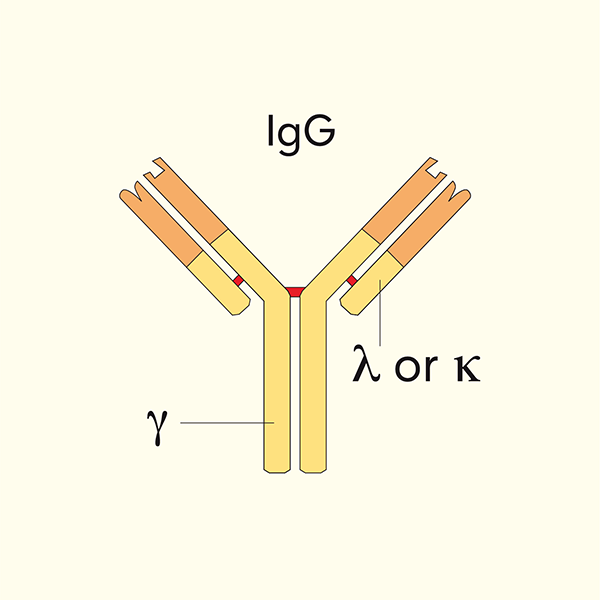
Syd Labs体内实验级重组抗人 CD3 单克隆抗体,克隆号 SK7,恒定区为小鼠 IgG1 Kappa(Mouse IgG1 Kappa),由哺乳动物细胞重组表达,靶向人 CD3 分子。CD3 又称 cluster of differentiation 3(分化簇3)、CD3D(CD3δ链)、CD3E(CD3ε链)、CD3G(CD3γ链),是与 T 细胞受体(TCR)非共价结合的跨膜信号复合物,由 CD3γε 与 CD3δε 异二聚体及 CD3ζζ 同二聚体(CD247)组成;其中 CD3γ、CD3δ、CD3ε 各含一个胞外免疫球蛋白样结构域和一段含单个 ITAM(免疫受体酪氨酸激活基序)的胞浆尾,CD3ζ 胞外区极短、胞浆尾含三个 ITAM。CD3 表达于所有成熟 T 淋巴细胞(CD4⁺、CD8⁺)、NKT 细胞及部分胸腺细胞表面,是 T 细胞最经典、最稳定的谱系标志;当 TCR 识别抗原肽-MHC 后,CD3 亚基 ITAM 被 Lck 磷酸化,招募并激活 ZAP-70,进而启动下游 T 细胞活化信号,因此 CD3 是 T 细胞抗原识别与信号转导的核心枢纽。SK7 是广泛用于临床流式细胞术与科研的抗人 CD3 经典克隆,识别 CD3ε 链表位,可用于 T 细胞群门控与计数、T 细胞活化与功能研究、TCR 敲除验证及 CD3 靶向药物研发中的检测。本品经 Protein G 亲和纯化,还原性 SDS-PAGE 及 HPLC 检测纯度>95%,LAL 法内毒素<1 EU/mg,0.2 μM 过滤于 pH 7.4、不含稳定剂或防腐剂的 1× PBS 溶液,适用于 ELISA、中和实验、功能实验(如生物分析 PK 与 ADA 检测)以及研究受人 CD3 蛋白影响的生物学通路的实验和体内动物实验。
产品参数
| 货号 | PA007682.m1 |
|---|---|
| 产品名称 | 重组抗人CD3单抗(SK7) | Syd Labs PA007682.m1 |
| 英文名 | In Vivo Grade Recombinant Anti-human CD3 Monoclonal Antibody (Clone: SK7), Mouse IgG1 Kappa |
| 供货商名称 | Syd Labs, Inc. |
| 品牌名 | Syd Labs |
| 别称 | cluster of differentiation 3(分化簇3)、CD3D、CD3E、CD3G |
| 克隆号 | SK7 |
| 同种型 | 小鼠 IgG1 Kappa |
| 特异性 | 该体内实验级重组小鼠单克隆抗体(克隆号 SK7)特异性结合人 CD3 D11b |
| 抗体形式 | 0.2 μM 过滤的溶液,pH 7.4,不含稳定剂或防腐剂 |
| 内毒素 | LAL 法测定,低于每 1 mg 蛋白 1 EU |
| 纯度 | 还原性条件下 SDS-PAGE 及 HPLC 检测>95% |
| 运输 | 采用冰袋运输;收到后请立即按下方推荐温度保存 |
| 稳定性与存储 | 使用手动除霜冰箱,避免反复冻融;自收货之日起 12 个月,按供货状态于 −20 ℃ 至 −70 ℃ 保存;自收货之日起 1 个月,按供货状态于 2 ℃ 至 8 ℃ 保存 |
| 产品咨询 | Syd Labs在国内只通过代理商销售其产品,不做直销。终端用户咨询价格请联系Syd Labs中国代理商。 关于Syd Labs产品如果有任何技术或其它问题,欢迎随时联系Syd Labs国内市场推广合作伙伴:武汉多找找科技有限公司,企业微信:duozhaozhao2024 联系电话:18162581039(龙经理) |
| 应用详情 | ELISA、中和实验、功能实验(如生物分析 PK 与 ADA 检测),以及研究受人 CD3 蛋白影响的生物学通路的实验 |
文献
PA007682.m1: Syd Labs 重组抗人CD3单克隆抗体(克隆号SK7) ,体内实验级重组,小鼠IgG1 Kappa(In Vivo Grade Recombinant Anti-human CD3 Monoclonal Antibody (Clone: SK7), Mouse IgG1 Kappa)
重组抗人CD3单抗(SK7)背景知识:
CD3 是与 T 细胞受体(TCR)非共价偶联的跨膜信号复合物,也是 T 细胞最经典、最稳定的表面谱系标志。其名称与别名对应关系如下:
cluster of differentiation 3(分化簇3):CD3 复合物的统一命名,”CD”为国际白细胞分化抗原编号体系;
CD3D:编码 CD3δ 链的基因,与 CD3γ、CD3ε 同属免疫球蛋白超家族;
CD3E:编码 CD3ε 链的基因,是 CD3 复合物组装的限速亚基,也是多数抗人 CD3 抗体(含 SK7)的主要识别对象;
CD3G:编码 CD3γ 链的基因;
除以上三者外,复合物还包含第五个成员 CD3ζ(基因 CD247),其胞外区很短、胞浆尾最长。
CD3 结构上由 CD3γε 与 CD3δε 两个异二聚体加 CD3ζζ 同二聚体构成,与 TCRαβ 以 1:1:1:1 化学计量比组装。CD3γ、CD3δ、CD3ε 各含一个胞外 Ig 样结构域、一个跨膜螺旋和一段含单个 ITAM 基序的胞浆尾;CD3ζ 胞浆尾含三个 ITAM。人 CD3D、CD3E、CD3G 基因均位于 11 号染色体 11q23.3,CD247 位于 1 号染色体 1q24.2,三者(CD3D/E/G)的紧密连锁反映了该复合物的共进化关系。
重组抗人CD3单抗(SK7)部分参考文献:
1. Structural basis of assembly of the human T cell receptor-CD3 complex.
Dong D, Zheng L, Lin J, Zhang B, Zhu Y, Li N, Xie S, Wang Y, Gao N, Huang Z
Nature. 2019 Sep;573(7775):546–552. PMID: 31461748 DOI: 10.1038/s41586-019-1537-0
“The αβ T cell receptor (TCR), in association with the CD3γε-CD3δε-CD3ζζ signalling hexamer, is the primary determinant of T cell development and activation, and of immune responses to foreign antigens. The mechanism of assembly of the TCR-CD3 complex remains unknown. Here we report a cryo-electron microscopy structure of human TCRαβ in complex with the CD3 hexamer at 3.7 Å resolution. The structure contains the complete extracellular domains and all the transmembrane helices of TCR-CD3. The octameric TCR-CD3 complex is assembled with 1:1:1:1 stoichiometry of TCRαβ:CD3γε:CD3δε:CD3ζζ. Assembly of the extracellular domains of TCR-CD3 is mediated by the constant domains and connecting peptides of TCRαβ that pack against CD3γε-CD3δε, forming a trimer-like structure proximal to the plasma membrane. The transmembrane segment of the CD3 complex adopts a barrel-like structure formed by interaction of the two transmembrane helices of CD3ζζ with those of CD3γε and CD3δε. Insertion of the transmembrane helices of TCRαβ into the barrel-like structure via both hydrophobic and ionic interactions results in transmembrane assembly of the TCR-CD3 complex. Together, our data reveal the structural basis for TCR-CD3 complex assembly, providing clues to TCR triggering and a foundation for rational design of immunotherapies that target the complex.”
2.Molecular architecture of the αβ T cell receptor–CD3 complex.
Birnbaum ME, Berry R, Hsiao YS, Chen Z, Shingu-Vazquez MA, Yu X, Waghray D, Fischer S, McCluskey J, Rossjohn J, Walz T, Garcia KC
Proc Natl Acad Sci U S A. 2014 Nov 24;111(49):17576–17581. PMCID: PMC4267357 PMID: 25422432 DOI: 10.1073/pnas.1420936111
“αβ T-cell receptor (TCR) activation plays a crucial role for T-cell function. However, the TCR itself does not possess signaling domains. Instead, the TCR is noncovalently coupled to a conserved multisubunit signaling apparatus, the CD3 complex, that comprises the CD3εγ, CD3εδ, and CD3ζζ dimers. How antigen ligation by the TCR triggers CD3 activation and what structural role the CD3 extracellular domains (ECDs) play in the assembled TCR–CD3 complex remain unclear. Here, we use two complementary structural approaches to gain insight into the overall organization of the TCR–CD3 complex. Small-angle X-ray scattering of the soluble TCR–CD3εδ complex reveals the CD3εδ ECDs to sit underneath the TCR α-chain. The observed arrangement is consistent with EM images of the entire TCR–CD3 integral membrane complex, in which the CD3εδ and CD3εγ subunits were situated underneath the TCR α-chain and TCR β-chain, respectively. Interestingly, the TCR–CD3 transmembrane complex bound to peptide–MHC is a dimer in which two TCRs project outward from a central core composed of the CD3 ECDs and the TCR and CD3 transmembrane domains. This arrangement suggests a potential ligand-dependent dimerization mechanism for TCR signaling. Collectively, our data advance our understanding of the molecular organization of the TCR–CD3 complex, and provides a conceptual framework for the TCR activation mechanism.”
3.Structural Biology of the T-cell Receptor: Insights into Receptor Assembly, Ligand Recognition, and Initiation of Signaling.
Wucherpfennig KW, Gagnon E, Call MJ, Huseby ES, Call ME
Cold Spring Harb Perspect Biol. 2010 Apr;2(4):a005140. PMCID: PMC2845206 PMID: 20452950 DOI: 10.1101/cshperspect.a005140
“The T-cell receptor (TCR)-CD3 complex serves as a central paradigm for general principles of receptor assembly, ligand recognition, and signaling in the immune system. There is no other receptor system that matches the diversity of both receptor and ligand components. The recent expansion of the immunological structural database is beginning to identify key principles of MHC and peptide recognition. The multicomponent assembly of the TCR complex illustrates general principles used by many receptors in the immune system, which rely on basic and acidic transmembrane residues to guide assembly. The intrinsic binding of the cytoplasmic domains of the CD3ε and ζ chains to the inner leaflet of the plasma membrane represents a novel mechanism for control of receptor activation: Insertion of critical CD3ε tyrosines into the hydrophobic membrane core prevents their phosphorylation before receptor engagement.”
4.One-step CRISPR-Cas9-mediated knockout of native TCRαβ genes in human T cells using RNA electroporation.
Flumens D, Campillo-Davo D, Janssens I, Roex G, De Waele J, Anguille S, Lion E
STAR Protoc. 2023 Mar 17;4(1):102112. PMCID: PMC9943861 PMID: 36853667 DOI: 10.1016/j.xpro.2023.102112
“To avoid mispairing between native and introduced T cell receptors (TCRs) and to prevent graft-versus-host disease in allogeneic T cell therapies, TCRα and TCRβ chains of native TCRs are knocked out via CRISPR-Cas9. We demonstrate the isolation and activation of CD8+ T cells followed by electroporation of T cells with in vitro transcribed eSpCas9(1.1)-P2A-EGFP mRNA and single-guide RNAs targeting the TCRα and TCRβ constant regions. We then describe a flow cytometric analysis to determine TCR knockout efficiency.”