重组抗HIV V1V2环糖基单克隆抗体(PG9) 人IgG1 Lambda | Syd Labs PA007183
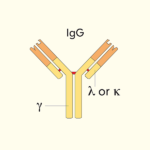
Syd Labs生产的体内实验级重组抗HIV V1V2环糖基单克隆抗体(克隆PG9)为哺乳动物细胞表达的全长人IgG1 Lambda抗体,是Walker/Burton团队2009年从非洲精英中和者(IAVI Protocol G Donor IAVI 25)分离的、首株靶向HIV-1 gp120 V1V2环N160糖基超位点的广谱中和抗体(bNAb);重链使用IGHV3-33*01胚系基因,携带28个氨基酸的锤头形CDRH3,通过”链-链”识别结合融合前闭合态Env三聚体顶端由V1V2 β-桶与N160/N156/N173高甘露糖基共同构成的跨protomer四元构象表位(quaternary epitope),对约79%跨亚型HIV-1分离株具高中和活性,是PGT145、CH01-CH04、CAP256-VRC26等V1V2顶端bNAb的原型;其Fab与V1V2支架复合物晶体结构(PDB 3U4E,1.8 Å)于2011年解析,是V1V2β-折叠构象和RV144疫苗V1V2免疫相关分析的核心参考分子,适用于HIV-1中和实验、Env三聚体顶端结构生物学、V1V2糖基超位点识别与疫苗设计研究、RV144后V1V2疫苗质量评价及多种体内外功能实验。
产品参数
| 货号 | PA007183 |
|---|---|
| 产品名称 | 重组抗HIV V1V2环糖基单克隆抗体(PG9) 人IgG1 Lambda | Syd Labs PA007183 |
| 英文名 | In Vivo Grade Recombinant Anti-HIV V1V2 Loop Glycan Monoclonal Antibody (Clone PG9), Human IgG1 Lambda |
| 供货商名称 | Syd Labs, Inc. |
| 品牌名 | Syd Labs |
| 克隆号 | PG9 |
| 同种型 | 人 IgG1,Lambda |
| 反应性 | HIV-1(跨亚型,约 79% 假病毒被中和,几何平均 IC50 约 0.2 μg/mL,严格依赖 N160 糖基与三聚体闭合态构象) |
| 特异性 | HIV gp120 V1V2环糖基超位点(V1V2-glycan / N160-glycan quaternary epitope,三聚体顶端四元构象表位) |
| 抗体形式 | 0.2 μm 过滤的 1× PBS 溶液 |
| 内毒素 | <1 EU/mg(LAL 法测定) |
| 纯度 | >95%(还原性 SDS-PAGE) |
| 运输 | 冰袋运输,收到后请立即按推荐条件储存 |
| 稳定性与存储 | 使用手动除霜冰箱并避免反复冻融循环。2-8℃自收到之日起可保存1个月;-20℃至-70℃自收到之日起可保存12个月,建议分装保存 |
| 产品咨询 | Syd Labs在国内只通过代理商销售其产品,不做直销。终端用户咨询价格请联系Syd Labs中国代理商。 关于Syd Labs产品如果有任何技术或其它问题,欢迎随时联系Syd Labs国内市场推广合作伙伴:武汉多找找科技有限公司,企业微信:duozhaozhao2024 联系电话:18162581039(龙经理) |
| 应用详情 | ELISA、Western blot、免疫组化(IHC)、流式细胞术(FC)、HIV-1中和实验、Env三聚体顶端/四元表位结构生物学(结晶辅助与冷冻电镜)、V1V2糖基超位点识别与疫苗设计研究、RV144/HVTN V1V2疫苗免疫原性质量评价及多种体内外功能实验 |
文献
重组抗HIV V1V2环糖基单克隆抗体(PG9) 人IgG1 Lambda,体内实验级(In Vivo Grade Recombinant Anti-HIV V1V2 Loop Glycan Monoclonal Antibody (Clone PG9), Human IgG1 Lambda)
重组抗HIV V1V2环糖基单克隆抗体背景知识:
HIV-1包膜糖蛋白Env三聚体顶端(apex)是V1、V2可变环与多组N-糖基共同构成的高度动态区域,负责与宿主细胞共受体(CCR5/CXCR4)结合并参与CD4结合后的构象重排。该区域在融合前闭合态中组装成由三个V1V2域环抱构成的”V1V2 cap”,每个V1V2呈希腊钥匙样β-桶折叠(β-barrel),N160、N156、N173等保守N-糖基覆盖其表面形成糖基屏障。该顶端区域被一类高度特殊的广谱中和抗体靶向——这些抗体均依赖Env三聚体构象(quaternary-specific),只结合天然闭合态三聚体而不识别单体gp120,并以长CDRH3穿透糖基屏障、通过”链-链”(strand-strand)识别方式结合V1V2 β-折叠C链。PG9、PG16、CH01–CH04、PGT145、CAP256-VRC26等均属此”V1V2顶端bNAb”家族,其中PG9是历史上首株被完整鉴定的该类抗体。
克隆PG9由Burton团队Laura Walker等2009年在Science上首次报道,是首批在IAVI Protocol G队列非洲精英中和者(Donor 25)中分离出的”下一代”高效bNAb之一。与其配对抗体PG16相比,PG9对N160糖基的依赖性更严格、中和广度略宽(约79%跨亚型假病毒),几何平均IC50约0.2 μg/mL,在当时报道中明显优于b12、2G12、2F5、4E10等第一代HIV bNAb。2011年McLellan等在Nature发表PG9 Fab与V1V2支架(ZM109株engineered V1V2)复合物1.8 Å高分辨晶体结构(PDB 3U4E),首次揭示V1V2采用β-折叠四链β-桶构象(而非此前推测的柔性无序环),PG9通过其28 aa长、带硫酸化酪氨酸的锤头形CDRH3横跨两个相邻V1V2域之间,β-发夹顶端插入糖基缝隙、以主链-主链氢键和侧链阳离子位点(sulfotyrosine 100G、Arg 100H等)”链-链”结合V1V2 C链并环抱N160高甘露糖——这一发现推翻了此前对V1V2结构的认知,并直接为后续SOSIP三聚体结构解析和V1V2靶向疫苗设计奠定结构基础。
PG9在HIV疫苗研究史上具有里程碑意义:2012年Haynes等在New England Journal of Medicine报道的RV144泰国HIV疫苗试验免疫相关分析显示,疫苗诱导的抗V1V2 IgG抗体水平与保护效力正相关(这是历史上首个在人体显示出部分保护效力的HIV疫苗),而PG9所识别的V1V2β-桶构象正是该免疫相关应答的核心靶标。基于PG9/PG16等V1V2 bNAb定义的构象表位,后续开发了gp70-V1V2支架、A244 V1V2 tag、Mosaic V1V2免疫原等多种V1V2疫苗候选;2013年Julien等Science报道的BG505 SOSIP.664首个高分辨晶体结构也以PG9、PGT128、35O22等抗体作为关键抗原性探针,证实SOSIP三聚体以PG9敏感的闭合态呈现V1V2顶端表位。
本品为体内实验级(In Vivo Grade)制剂,来源于哺乳动物细胞表达的重组全长人IgG1 Lambda,内毒素低于1 EU/mg、配方为无防腐剂的1× PBS,适合用于HIV-1中和实验、Env三聚体顶端V1V2糖基超位点四元识别机制研究、SOSIP/Env三聚体结构生物学(含Fab辅助结晶、冷冻电镜样品制备与抗原性图谱分析)、RV144/后RV144 V1V2疫苗免疫原质量评价、V1V2靶向抗体应答检测,以及需要低内毒素背景的SHIV恒河猴/人源化小鼠体内被动保护等多种体内外功能实验。使用前请根据实验体系确定工作浓度,并避免反复冻融。
重组抗HIV V1V2环糖基单克隆抗体部分参考文献:
1.Broad and potent neutralizing antibodies from an African donor reveal a new HIV-1 vaccine target Laura M Walker,et al.Science. 2009.PMCID: PMC2841737 “Broadly neutralizing antibodies (bNAbs) to HIV-1 can prevent infection and are therefore of great importance for HIV-1 vaccine design and immunoprophylaxis. Here, we describe the generation and characterization of two exceptionally potent and broad HIV-1-neutralizing antibodies, PG9 and PG16, from an HIV-1 clade A-infected African donor (IAVI Protocol G donor 25). PG9 and PG16 neutralize approximately 78-79% of viruses tested with geometric mean IC50 values of 0.2 and 0.03 µg/ml, respectively, and they are more potent and broader than previously described bNAbs. These antibodies bind to a novel quaternary, glycan-dependent epitope in the V1/V2 region of gp120 that is only presented on the assembled envelope trimer, defining a previously unrecognized supersite of vulnerability on the HIV-1 envelope that is a promising target for vaccine design.”
2. Structure of HIV-1 gp120 V1/V2 domain with broadly neutralizing antibody PG9 Jason S McLellan,et al.Nature. 2011.PMCID: PMC3243115 “Variable regions 1 and 2 (V1/V2) of human immunodeficiency virus-1 (HIV-1) gp120 envelope glycoprotein are critical for viral evasion of antibody neutralization, and are themselves targets of a new class of potent broadly neutralizing antibodies (bNAbs) that includes PG9 and PG16. Here we report the crystal structure of the antigen-binding fragment (Fab) of PG9 in complex with a scaffolded V1/V2 domain engineered from a clade C HIV-1 strain (ZM109) at 1.8 Å resolution. The structure reveals that V1/V2 adopts a four-stranded β-sheet Greek-key fold, in which strands B, C and D form a compact β-barrel. PG9 uses a long, hammerhead-shaped CDR H3 that contains a sulfated tyrosine at its tip to reach across the apex of two adjacent gp120 protomers, engaging the protein backbone of strand C through main-chain β-sheet hydrogen bonding and simultaneously contacting the conserved N160 glycan. The structure explains the quaternary, glycan-dependent nature of PG9 recognition and suggests that V1/V2-directed bNAbs target the closed, prefusion form of the envelope trimer.”
3. Crystal structure of a soluble cleaved HIV-1 envelope trimer Jean-Philippe Julien,et al.Science. 2013.PMCID: PMC3885649 “HIV-1 entry into CD4+ T cells is mediated by the envelope (Env) glycoprotein spike, a trimer of gp120-gp41 heterodimers that is the sole target of neutralizing antibodies. Here we report the crystal structure at 4.7 Å resolution of a soluble, cleaved, stabilized gp140 trimer (BG505 SOSIP.664) derived from a clade A transmitted/founder virus, the first atomic-resolution structure of a cleaved, native-like HIV-1 Env trimer. The trimer adopts a compact, mushroom-shaped conformation in which the V1V2 and V3 loops are sequestered at the trimer apex. Antigenic mapping with a panel of bNAbs, including the V1V2-apex-directed antibodies PG9 and PG16 as well as PGT128, PGT122, 35O22 and VRC01, shows that BG505 SOSIP.664 faithfully recapitulates quaternary epitopes at the trimer apex and provides a high-resolution template for HIV-1 vaccine design.”
4. Structures of HIV-1 Env V1V2 with broadly neutralizing antibodies reveal commonalities that enable vaccine design Jason Gorman,et al.Nat Struct Mol Biol. 2016.PMCID: PMC4722598 “Broadly neutralizing antibodies (bNAbs) against the V1V2-apex site of the HIV-1 envelope (Env) trimer are promising targets for HIV-1 vaccine design. To define common structural features of V1V2 recognition, we determined crystal structures of bNAbs PG9, PG16, PGT145 and CH03 in complex with scaffolded V1V2 domains, and analyzed these in the context of the high-resolution Env trimer. All V1V2-apex bNAbs use long, tyrosine-sulfated CDR H3 loops to penetrate the glycan shield and engage a conserved β-strand motif in V1V2 via strand-strand interactions with the N160 glycan. Comparison with the RV144 vaccine-elicited antibody CH58 reveals that vaccine-induced antibodies can engage the same V1V2 β-strand but approach from a different angle, without recognizing the N160 glycan or the quaternary trimer. These results highlight common structural requirements for potent V1V2 neutralization and provide atomic-level templates for structure-guided vaccine design aimed at eliciting PG9-like bNAbs.”
5. Immune-correlates analysis of an HIV-1 vaccine efficacy trial Barton F Haynes,et al.N Engl J Med. 2012.PMCID: PMC3459909 “The Thai RV144 HIV-1 vaccine trial demonstrated a modest but significant 31.2% reduction in HIV-1 acquisition, providing the first evidence that an HIV-1 vaccine can protect humans from infection. To identify immune correlates of protection, we measured six primary variables in vaccine-induced immune responses in vaccinated and placebo recipients: IgG antibody binding to three Env antigens, plasma neutralizing activity, antibody-dependent cellular cytotoxicity (ADCC), and Env-specific CD4+ T-cell responses. In a primary analysis using a logistic regression model, IgG antibodies binding to the V1V2 region of gp120 correlated inversely with the risk of HIV-1 infection (odds ratio 0.57 per 1 SD increase), whereas other immune responses did not. These findings identify V1V2-binding IgG antibodies as a primary correlate of reduced infection risk in RV144 and focus HIV-1 vaccine development on inducing high levels of antibodies that recognize the PG9-sensitive conformational epitope in the V1V2 region of the HIV-1 envelope.”