重组嵌合人IgG4-S228P同型对照抗体(4F17m) | Syd Labs PA007194
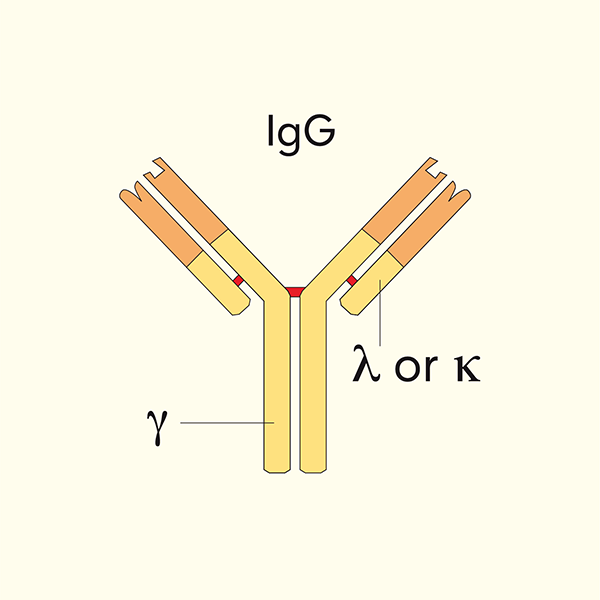
Syd Labs生产的体内实验级重组嵌合人IgG4-S228P kappa同型对照抗体,克隆号 4F17m,由Syd Labs在哺乳动物细胞中重组表达。人IgG4天然具有较弱的Fc效应功能(ADCC/ADCP/CDC活性低),常用于需要”阻断性但不激活”的治疗性抗体骨架,但野生型IgG4铰链区Cys-Pro-Ser-Cys序列会在体内/还原条件下发生Fab臂交换(Fab-arm exchange, FAE),产生双特异性半分子,导致抗体特异性与效价不可控。本品在铰链区引入经典 S228P(EU编号)点突变,将核心铰链序列稳定为Cys-Pro-Pro-Cys,有效抑制Fab臂交换至检测不到的水平,确保在血清及动物体内实验中抗体分子保持完整、特异性均一。该抗体不含已知特异性靶标,与经测试的人体样本无/低特异性结合,经Protein A亲和纯化、SDS-PAGE纯度>95%、LAL法内毒素<1 EU/mg、0.2 μm无菌过滤,1× PBS配方,是体内外IgG4 kappa亚型治疗/研究抗体最匹配的阴性对照,广泛用于流式细胞术(FC/FACS)、免疫组化(IHC)、Western blot、免疫沉淀(IP)以及小鼠/大鼠等小动物模型的体内药物分布、毒性、药代、PD-1/PD-L1、IL-6/TNF-α等IgG4-S228P亚型治疗性抗体的同型对照实验。
产品参数
| 货号 | PA007194 |
|---|---|
| 产品名称 | 重组嵌合人IgG4-S228P同型对照抗体(4F17m) | Syd Labs PA007194 |
| 英文名 | In Vivo Grade Recombinant Chimeric Human IgG4-S228P Isotype Control Antibody |
| 供货商名称 | Syd Labs, Inc. |
| 品牌名 | Syd Labs |
| 克隆号 | 4F17m |
| 同种型 | 人IgG4-S228P, kappa |
| 特异性 | 无已知靶抗原;与经测试的人源样本低/无特异性结合 |
| 免疫源 | 不适用(N/A)。 |
| 抗体形式 | 0.2 μm 过滤的 1× PBS 溶液 |
| 内毒素 | <1 EU/mg(LAL 法测定) |
| 纯度 | >95%(还原性 SDS-PAGE) |
| 运输 | 本产品采用冰袋运输。收到后,请立即按下文推荐温度保存。 |
| 稳定性与存储 | 请使用手动除霜冰箱,并避免反复冻融循环。 自收货之日起1个月,按供货状态在2–8 ℃保存。 自收货之日起12个月,按供货状态在−20 ℃至−70 ℃保存。 |
| 注意事项 | 仅供科研使用(For Research Use Only),不可用于人体治疗或诊断;同型对照不能替代Fc受体封闭,FC实验建议联用Fc block |
| 产品咨询 | Syd Labs在国内只通过代理商销售其产品,不做直销。终端用户咨询价格请联系Syd Labs中国代理商。 关于Syd Labs产品如果有任何技术或其它问题,欢迎随时联系Syd Labs国内市场推广合作伙伴:武汉多找找科技有限公司,企业微信:duozhaozhao2024 联系电话:18162581039(龙经理) |
| 应用详情 | 作为人IgG4 kappa抗体的同型匹配阴性对照,适用于ELISA、蛋白免疫印迹(Western Blot, WB)、流式细胞术(Flow Cytometry, Flow)、免疫沉淀(Immunoprecipitation, IP)、石蜡切片免疫组化(Immunohistochemistry (Paraffin), IHC (P))、冰冻切片免疫组化(Immunohistochemistry (Frozen), IHC (F))以及体内动物模型研究。 |
文献
重组嵌合人IgG4-S228P同型对照抗体(4F17m),体内实验级(In Vivo Grade Recombinant Chimeric Human IgG4-S228P Isotype Control Antibody)
重组嵌合人IgG4-S228P同型对照抗体背景知识:
同型对照抗体(Isotype Control Antibody)的作用
同型对照抗体是免疫学实验中用于排除Fc受体非特异结合、抗体非特异性吸附与第二试剂背景的关键阴性对照。理想的同型对照抗体必须与实验用一抗在宿主种属、Ig亚型、轻链类型、浓度、标记形式与给药剂量上完全匹配,但对抗原无任何特异性结合。在体内动物实验中,同型对照更承担着排除非特异Fc效应、聚体介导清除、非靶向免疫激活等干扰因素的功能,因此要求极低内毒素(<1 EU/mg)、低聚合体、无菌、无防腐剂的体内实验级(In Vivo Grade)标准。
为什么是 IgG4-S228P?
人IgG有四个亚类:IgG1、IgG2、IgG3、IgG4。其中IgG4由于铰链区和CH2/CH3的关键氨基酸差异(L234F、A327G、P331S),与FcγR和C1q的结合能力显著降低,天然具有弱ADCC、弱CDC、弱ADCP等”沉默效应”特征,是治疗性抗体常用的骨架之一(包括抗PD-1抗体派姆单抗Keytruda®、纳武单抗Opdivo®等已上市IgG4药物)。
然而天然IgG4存在一项特殊性质——Fab臂交换(Fab-arm exchange, FAE):其核心铰链区序列为Cys-Pro-Ser-Cys(CPSC),第228位的丝氨酸使重链间二硫键不稳定;在生理浓度的谷胱甘肽(GSH)或血液还原环境下,两个不同IgG4分子可交换半个分子(一条重链+一条轻链),形成功能单价、双特异性的杂合抗体,导致抗体特异性改变、效价下降、交联能力丧失,并可能在体内与其他内源性IgG4发生交换而产生不可预期的免疫效应。
S228P铰链突变(Ser228→Pro,EU编号)将核心铰链改为Cys-Pro-Pro-Cys(CPPC,与IgG1相同),显著增强重链间二硫键稳定性。Silva等人(2015,J Biol Chem)和后续多项研究通过SDS-PAGE、FRET荧光共振能量转移、混合模式色谱、LC-MS及SCID小鼠体内实验反复证实:S228P突变可将IgG4的Fab臂交换抑制至体外及体内均检测不到的水平,同时不影响IgG4的Fc沉默表型、抗原结合能力与药代动力学。这一突变已成为全球几乎所有IgG4治疗性单抗(Keytruda®、Tecentriq®等)的标准工程改造,也成为科研用IgG4同型对照抗体的金标准骨架。
PA007194的应用场景
IgG4类治疗性抗体的体内外阴性对照:与派姆单抗、纳武单抗等S228P骨架的anti-PD-1抗体,以及抗IL-6、抗TNF-α、抗IL-17、抗PD-L1(部分IgG4骨架)抗体同种型完全匹配。
人源化/嵌合IgG4抗体药物临床前研究:药代动力学、组织分布、毒性评估、非特异摄取对照。
流式/IHC/WB/IF/IP阴性对照:评估Fc受体结合、二抗背景、非特异染色。
双特异性抗体、ADC、CAR-T/CAR-NK联合用药对照:与hIgG4-S228P骨架药物联用或平行实验。
疫苗与血清学研究:排除人血清中IgG4类非特异性反应。
本品采用嵌合可变区(克隆4F17m),不识别HEL、TNP等常见模式抗原,也与经测试的人/小鼠/大鼠组织样本低/无交叉反应,作为同型对照背景极低,适合高灵敏度实验。
重组嵌合人IgG4-S228P同型对照抗体部分参考文献:
1.The S228P Mutation Prevents in Vivo and in Vitro IgG4 Fab-arm Exchange as Demonstrated using a Combination of Novel Quantitative Immunoassays and Physiological Matrix Preparation
John-Paul Silva, Olivia Vetterlein, Joby Jose, Shirley Peters, Hishani Kirby
J Biol Chem. 2015;290(9):5490–5506. PMCID: PMC4342462 PMID: 25568323 DOI: 10.1074/jbc.M114.607346
“Human immunoglobulin G isotype 4 (IgG4) antibodies are potential candidates for immunotherapy when reduced effector functions are desirable. IgG4 Abs are dynamic molecules able to undergo a process known as Fab arm exchange (FAE). This results in functionally monovalent, bispecific antibodies with unknown specificity and hence, potentially, reduced therapeutic efficacy. Using representative humanized WT IgG4 monoclonal Abs, namely, anti-IL-6 and anti-TNF, and a core-hinge stabilized serine 228 to proline (S228P) anti-IL-6 IgG4 mutant, we developed a novel quantitative method for measuring FAE in physiologically relevant matrices using affinity chromatography and mixed-mode chromatography. We demonstrate that the S228P hinge mutation inhibits IgG4 FAE to undetectable levels both in vitro (PBS, human serum) and in vivo (SCID mice), providing key regulatory-grade evidence that S228P-stabilized IgG4 is suitable for biotherapeutic and in vivo research applications.”
2.Therapeutic IgG4 Antibodies Engage in Fab-arm Exchange in Vivo
Aran F. Labrijn, et al.
Nat Biotechnol. 2009;27(8):767–771. PMCID: PMC2652299 PMID: 19578372 DOI: 10.1038/nbt.1553
“IgG4 antibodies have a unique ability to exchange half-molecules (Fab arms), resulting in bispecific antibodies that lose the ability to cross-link antigen. We show that therapeutic IgG4 antibodies, such as natalizumab, undergo Fab-arm exchange with endogenous IgG4 in human blood and in mice in vivo, generating hybrid molecules with unknown specificity. Introduction of the S228P mutation in the core hinge abolishes FAE, preserving monospecificity in vivo—a modification that has since been universally adopted for clinical-stage IgG4 therapeutics.”
3.Anti-inflammatory Action of IgG4: The Fab-arm Exchange Hypothesis
Rob C. Aalberse, Janine Schuurman
Clin Chem. 2002;48(4):574–578. PMID: 11901057 (review)
“IgG4 antibodies are dynamic molecules that exchange Fab arms in vivo, yielding bispecific, functionally monovalent molecules. This process explains the limited ability of IgG4 to form large immune complexes and its anti-inflammatory characteristics. The S228P (formerly S241P in Kabat numbering) hinge mutation stabilizes inter-heavy-chain disulfide bonds, making IgG4 behave like a conventional monospecific antibody—key design rationale for S228P isotype controls used in contemporary preclinical and clinical research.”
4.IgG Subclasses and Allotypes: From Structure to Effector Functions
Gestur Vidarsson, Gillian Dekkers, Theo Rispens
Front Immunol. 2014;5:520. PMCID: PMC4243052 PMID: 25368619 DOI: 10.3389/fimmu.2014.00520
“Human IgG4 exhibits low binding to Fcγ receptors and to C1q, resulting in poor ADCC, ADCP and CDC effector functions. Its flexible but unstable core hinge (CPSC) permits Fab-arm exchange under reducing conditions. The S228P mutation aligns the IgG4 hinge with that of IgG1 (CPPC) and abrogates FAE without altering Fc-related silencing properties—making IgG4-S228P an ideal backbone for blocking antibodies and for isotype control antibodies used in in vivo studies.”
5.Human Immunoglobulin G4 (IgG4) Molecules Can Exchange Fab Arms in vivo: A Mechanism to Generate Bifunctional Antibodies (Controlled Fab-arm Exchange / Antibody Engineering)
Rob C. Aalberse, Rob J. van der Zee, S. O. Stapel, Janine Schuurman
Proc Natl Acad Sci USA. 1997;94(5):1924–1928. DOI: 10.1073/pnas.94.5.1924 PMID: 9050881
“We demonstrate that human IgG4 antibodies, unlike other IgG subclasses, can exchange Fab arms in vivo via a redox-controlled process involving the unstable core hinge. This property renders IgG4 functionally monovalent under physiological conditions. Our results identify the structural basis for IgG4’s anti-inflammatory behavior and establish the mechanistic foundation for why hinge stabilization (later achieved by S228P mutation) is essential for any IgG4 antibody intended to remain monospecific in circulation—an essential criterion for in vivo grade isotype control antibodies.”